
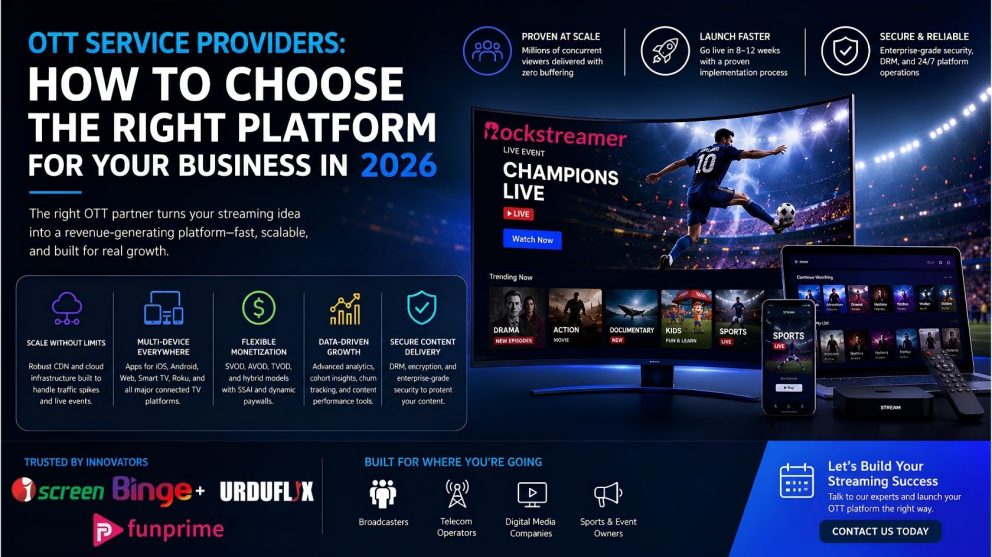
OTT service providers aren’t all built the same. Here’s what actually separates a strong platform partner from a weak one.
Choosing the right OTT service provider is one of the most consequential decisions a broadcaster, telecom, or content owner will make; it directly shapes launch speed, monetization potential and how well a platform scales as an audience grows. The right partner turns a streaming idea into a functioning, revenue-generating product in weeks. The wrong one turns it into a multi-year technical debt problem.
This guide breaks down what OTT service providers actually do, what separates a strong provider from a weak one and how to evaluate options without getting lost in feature-list marketing.
This guide draws on direct experience building and operating enterprise-grade OTT platforms, including live-event streaming to millions of concurrent viewers.
What Do OTT Service Providers Actually Do?
An OTT (Over-the-Top) service provider builds and operates the technology stack that lets a business deliver video content directly to viewers over the internet, bypassing traditional cable or satellite distribution entirely.
In practice, this covers several layers working together:
- Content delivery infrastructure (CDN): getting video to viewers quickly and reliably, regardless of device or location.
- Multi-device app development: building and maintaining apps across Smart TVs, Roku, mobile (iOS/Android), web, and connected-TV platforms.
- Monetization tooling: subscription billing (SVOD), ad-supported streaming (AVOD), server-side ad insertion (SSAI), and hybrid models that combine several revenue streams.
- Content management and analytics: tools for uploading, organizing, and scheduling content, plus data on viewer behavior, churn, and retention.
- Security and DRM: protecting content from piracy while keeping playback smooth across devices.
A good OTT service provider like Rockstreamer doesn’t just hand over software; it handles the operational complexity of running all of this reliably at scale so the business can focus on content and audience growth instead of infrastructure.
Key Criteria for Choosing an OTT Service Provider.
Not all providers are built the same way and the right fit depends heavily on business size, technical resources and growth timeline. These are the criteria that matter most in practice:
Scalability. Can the platform handle a spike in viewers during a live event without buffering or downtime? This matters especially for sports, news, or event-based streaming, where traffic is unpredictable and unforgiving.
Multi-device reach. Viewers expect to watch on whatever screen they own. A provider that only covers mobile and web – without Roku, Smart TV, or connected-TV app support, limits audience reach from day one.
Monetization flexibility. The strongest providers support multiple monetization models simultaneously, not just one. A platform locked into pure subscription billing can’t easily pivot to ad-supported tiers later without significant rework.
Implementation timeline. This is one of the most underestimated factors. Some providers can get a business live in 8–12 weeks with a defined onboarding process; others stretch implementation into 6+ months with unclear milestones. Ask for a specific, documented launch timeline – not a vague estimate.
Data-driven retention tools. Launching a platform is the easy part; keeping viewers engaged is the hard part. Cohort analytics, churn tracking and content performance data are what let a business actually grow ARPU (average revenue per user) and reduce drop-off over time, rather than just guessing at what content works.
Types of OTT Service Providers: Matching Provider to Business Size.
OTT service providers generally fall into three tiers and picking the wrong tier for your business size is one of the most common – and expensive – mistakes.
Enterprise-grade platforms are built for large broadcasters and telecoms with high concurrent viewership and complex compliance needs. They offer deep customization but often come with longer implementation timelines and higher costs.
Mid-market providers balance flexibility with speed — well-suited for regional broadcasters, sports platforms, and growing digital media companies that need real scalability without enterprise-level overhead or cost.
White-label/self-serve platforms are the fastest and cheapest way to launch, but typically offer the least customization and the weakest support for complex monetization or analytics needs. These work well for very early-stage or low-budget launches, but tend to become limiting as an audience grows. Matching business size and growth plans to the right tier upfront avoids the costly pattern of migrating platforms mid-growth — one of the most disruptive and expensive mistakes an OTT business can make.
A real-world example of enterprise-grade scale during the 2026 FIFA World Cup, Rockstreamer built and deployed a full enterprise-grade OTT streaming infrastructure across multiple live platforms in just 45 days, with a dedicated technical team operating around the clock through the tournament. The result was millions of concurrent users streaming with zero buffering, a benchmark that illustrates the gap between providers who can talk about scalability and providers who have actually proven it under real, high-stakes live-event load.
This same enterprise-grade infrastructure is what separates strong OTT service providers from the rest , it powers Rockstreamer’s own portfolio of platforms, including iScreen, Bing+, Funprime and Urdoflix – proof that the scalability behind this deployment isn’t a one-off, but the standard Rockstreamer builds on for every platform it operates.
Explore OTT Platforms Built by Rockstreamer.
Rockstreamer has built and powers a growing portfolio of live OTT platforms across markets. Explore them below:




Common Mistakes Businesses Make When Choosing an OTT Provider.
Choosing based on price alone. The cheapest provider often lacks the scalability or monetization flexibility needed for real growth, leading to a costly migration later.
Underestimating launch timelines. Businesses frequently assume “we’ll be live in a month” without confirming this with the provider directly – leading to missed launch windows tied to events, seasons, or marketing campaigns.
Ignoring analytics and retention tooling. Many businesses focus entirely on the launch and app experience, while treating analytics as an afterthought — then struggle to explain why viewers churn six months in.
Not confirming multi-device support upfront. Assuming “the provider covers everything” without explicitly confirming Roku, Smart TV, and connected-TV support has left more than one business scrambling to add device coverage post-launch.
Frequently Asked Question (FAQ).
The best fit for a mid-size broadcaster is typically a mid-market OTT provider that offers multi-device app support, hybrid monetization (subscription plus advertising), and a documented onboarding timeline – rather than an enterprise platform built for much larger scale, or a white-label platform that limits growth later.
How long does it take to launch an OTT platform?
A well-structured OTT launch – as Rockstreamer delivers – typically takes 8 to 12 weeks from kickoff to go-live, assuming content, branding, and monetization requirements are defined upfront. Providers offering vague or open-ended timelines are a warning sign worth investigating further before committing.
Do OTT service providers support both subscription and ad-supported models?
The strongest providers, like Rockstreamer, support hybrid monetization – combining subscription (SVOD) and advertising (AVOD) – rather than locking a business into a single revenue model. This flexibility matters because audience monetization preferences often shift after launch, and switching models later is far harder than building for both from the start.
What devices should an OTT platform support at launch?
At minimum, a competitive OTT launch should cover mobile (iOS/Android), web, Smart TV, and Roku — since these represent the majority of how viewers actually watch streaming content today. Missing any of these at launch limits addressable audience from day one.